THE MAJOR BARBARA PILOT PROJECT

Welcome to the Major Barbara Pilot Project! This page is dedicated to educating the public on the subject of the play Major Barbara, written by George Bernard Shaw and published in 1907. In this 20th century play, Shaw pens the character of Major Barbara, a woman born to wealth, who believes that by helping the poor and devoting her life to the Salvation Army, she can aid in saving the world. This ideal is shaken only after the introduction of the play’s antagonist, her estranged father, Andrew Undershaft, a wealthy businessman who unveils to her the hypocrisy of the Salvation Army. The play serves as a comedy filled with social commentary on a world fixated on money.
Please familiarize yourself with the Major Barbara page which yields to the various productions, videos, and electronic publications of the play.
The play was also adapted into a movie that made its way to theatres in 1941. Filmed during the Blitz bombing of 1941, the production team ran in various obstacles in which they had to overcome in order to finish the movie by its preconceived release date. Shaw was majorly involved in the production of this film as he adapted his play for the movie as a script and screenplay. The film stands to be one of the most successful is a lineup of collaborations between Shaw and director and producer Gabriel Pascal, gaining much critical and financial success during its run.
Click here to watch an excerpt of the 1941 movie in which Major Barbara gives her famous speech about happiness in finding God to the public.
Watch Part 1 and Part 2 of the full movie here.
On this page, you can find links to:
1) Film and video productions
2) Electronic Texts
3) Critical Essays and Notes
4) Some Images
*****************************************************************
1) Film and Video Productions
Find Major Barbara on Youtube
The first film adaption of Major Barbara was brought to life on the big screen in 1941. Directed by Gabriel Pascal, it stars Wendy Miller and Rex Harrison in the lead roles.
Here is the movie.
•http://www.youtube.com/watch?v=zQKoB4WsiNw
•http://www.youtube.com/watch?v=jGzFIjxODVA
Click here to watch the trailer in black and white!
Learn more about Major Barbara’s 1941 cast members here.
There are also several play adaptations of Major Barbara, one of which was performed in 2008 at the Shakespeare Theatre Company in Washington, USA. Produced by Ethan McSweeny, the trailer was posted to Youtube in order to garner views. Click here to watch it.
Another performance was held in 2010 at the Bedford Community Theatre and was directed by John Thompson. It features Debra Ablezer in the title role. Click here to watch the trailer.
Here is also a link to the Tacoma Little Theatre’s adaptation of the play from 2010.
Read a few reviews here.
List of Major Barbara Productions
In the United Kingdom
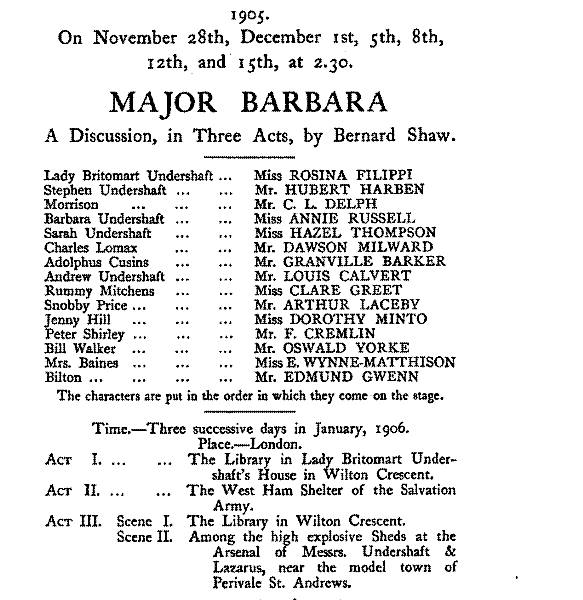
Royal Court Theatre, London, UK, 1905
Chichester Festival Centre, Sussex, UK, 1988
National Theatre, London, UK, 2008
In the United States of America
On Broadway at Playhouse Theatre, USA, 1915
Guild Theatre, New York, USA, 1928
Martin Beck Theatre, New York, USA, 1956
Morosco Theatre, New York, USA, 1956
Circle in the Square Theatre, New York, USA, 1980
American Airlines Theatre, New York, USA, 2001
2. Electronic Texts
The Project Gutenberg E-text of Major Barbara, by Bernard Shaw
Major Barbara on FullBooks
eNotes Study Guide version of Major Barbara
Major Barbara on SparkNotes
Download Major Barbara from Archive
Download Major Barbara from fulltextarchive
ebooksread download and document file of Major Barbara
Major Barbara Full Text on eserver
3. Critical Essays and Notes
Undershaft: An Analysis of Criticism of George Bernard Shaw’s Major Barbara, by Doug Ray
Major Barbara: Theme Analysis
Summary and Analysis of Shaw’s Preface to Major Barbara
Shaw’s “Major Barbara”: Collection of Critical Essays (20th Century Interpretations), Edited by Rose Zimbardo on Amazon.com
Major Theme Analysis of Major Barbara
Bernard Shaw: An Essay as First Aid to Critics
4. Some Images pertaining to Major Barbara


1941 Movie Poster for Major Barbara


Shakespeare Theatre Company

Pittsburg Irish and Classical Theatre (2003)


National Theatre Poster for Major Barbara
BACKGROUND INFORMATION: SALVATION ARMY
Major Barbara‘s plot centres around the titular character who has dedicated her life to working with the Salvation Army.
However, the Salvation Army does not begin with Shaw’s character Barbara Undershaft. Its foundation began with William Booth, a young man who began his professional career working as an apprentice in a pawnbroker’s shop. There he learned about humiliation and the degradation of poverty which eventually prompted him to become a minister. As a travelling minister, his goal was to attempt to educate the public of their “selfish and sinful” ways and begin a movement to eradicate the issues. He gained enough attention to be invited to hold religious meetings in London, England. There Booth founded an organization called “The Christian Mission“, which unfortunately, garnered little attention from the public. It wasn’t until 1878, when he changed the name to the “Salvation Army” that people started to join.
The idea of an army fighting to end sin and striving towards redemption signified the beginning of an important movement for the English people. Booth’s powerful sermons were finally gaining the attention they deserved.
Newly recruited soldiers of the Salvation Army were obligated to swear to the “Soldiers Covenant“.
After the name was changed, a uniform was introduced to the “army”. Different styled uniforms designated a different military rank. Specifically, trimmings worn on the uniform signified rank, seniority and responsibility in accordance with traditional military rankings.
In 1880, a standard navy blue serge uniform was worn by both men and women Salvationists. Men wore a high neck tunic with a stiff collar over a red jersey. Their uniform was accompanied by a military cap with a red band, emblazoned with the words The Salvation Army in gold. Women, on the other hand, wore long navy skirts, and fitted neck tunics with a lace collar. This was accompanied by a large black straw bonnet, with a red band and huge red ribbon bow on top.
Male Salvationists continued for a while to express their individuality through an assortment of headgear such as, pith helmets, toppers, derbies, sailor hats, and discarded military band helmets until 1891 when the soldiers were issued one hatband for officers, another for soldiers.
Many Salvation Army soldiers would also sport their uniforms to formal events such as, funerals, weddings, family portraits, visiting relatives and town hall meetings. This was not only because of the pride the uniform instilled in the soldier, but also because economic reasons: soldiers were obligated to purchase their own uniforms, and the clothing cost on average three weeks’ salary.
Recently, women soldiers have upgraded their headgear to smaller version of the Victorian bonnet. However, many countries have opted to purchase cheaper felt versions of the felt bowler-hat style. The high necked tunics are also being replaced by open-neck jackets.
Uniforms also vary depending on the country involved. According to the climate and culture of the country, white, grey, beige, safari sari has been adopted as well as a Salvation Army sash. Read here to find out more about what the Salvation Army stands for.
BACKGROUND INFORMATION: THE PLAY
These links provide information to the background story of the play, as well as an insight into its characters. As well as a link to several activities utilizing the plays themes which can be taught in the classroom in order to engage the students. Finally there is a glossary of terms to help understand the terminology pertinent to the theatrical world.
1941 Film with Wendy Hiller as Major Barbara
CHINESE WEBSITES ON MAJOR BARBARA
Here are some links to Chinese websites on Major Barbara:
Baidu Wikipedia entry on Major Barbara
Major Barbara on Baidu Text Collection
Major Barbara on SoSo Wikipedia
Major Barbara on IAsk Open Dictionary
Major Barbara: Texts and Bilingual Texts
Comments on Major Barbara
MONEY AND GUNPOWDER
MONEY
Although 19th century Britain was a leading nation in terms of industrial advancement, the 20th century marked a time of great economic depression. Countries such as Germany and the USA were proving to be highly competitive in the industrial race and began taking jobs away from Britain, leaving its citizens in poverty.
Travelling minster William Booth took it upon himself to educate the public of the reality of the situation. It wasn’t the poor that were leading the country down the path of financial decline, yet a number of reasons such as:
Unemployment or partial employment
Death or illness of the breadwinner
Low income
Large families and the unemployed
Movements to combat poverty came as government endorsed projects such as, the Unemployed Workmen’s Act in 1905, and the Employment of Children Act.
It became understood that the old were poor because of retirement and children were poor because their parents were poor. And in this case, with all three age groups being greatly affected, the Salvation Army found the perfect platform to spread their message.
Some facts about British currency in the 1900s!
Understand British currency now!
GUNPOWDER
Prior to the invention of gunpowder, many countries’ armed forces used various forms of early thermal weapons, including Greek Fire.
In a search funded by the Emperor Wu Di of the Han Dynasty in order to discover the elixir of life, 9th century Chinese taoist alchemists formulated gunpowder. The alchemists heated elements such as sulphur and potassium nitrate in the hopes of transforming them into this legendary potion. It was noted that when sulphur and potassium nitrate were combined with charcoal it created an explosive known commonly as: Gunpowder. Though gunpowder did not encourage the longevity of life, it was used a healing property to treat skin diseases before those discovered its potential as a weapon.

Read more about the history of gunpowder here.
Gunpowder also played a major role in the failed assassination attempt against the then King of England, King James I of England and VI of Scotland. Known in history as the Gunpowder Plot of 1605, it marked the climactic peak of the struggle between practising protestants and Catholics in England. On November 5th, 1605, those who had gathered together to plot against the king, decided to fill a cellar in the House of Lords with barrels of gunpowder. The plans were foiled, however, when one of the conspirators feared for the life of his brother-in-law, a member of Parliament – who would be attending the meeting that day – and sent a warning to him. The brother-in-law, Lord Monteagle, became suspicious and warned a man named Robert Cecil. Cecil then organized a search party and when they found the gunpowder they began to persecute those involved in the plot.